


How organisations create confidence at scale
GET IN TOUCH











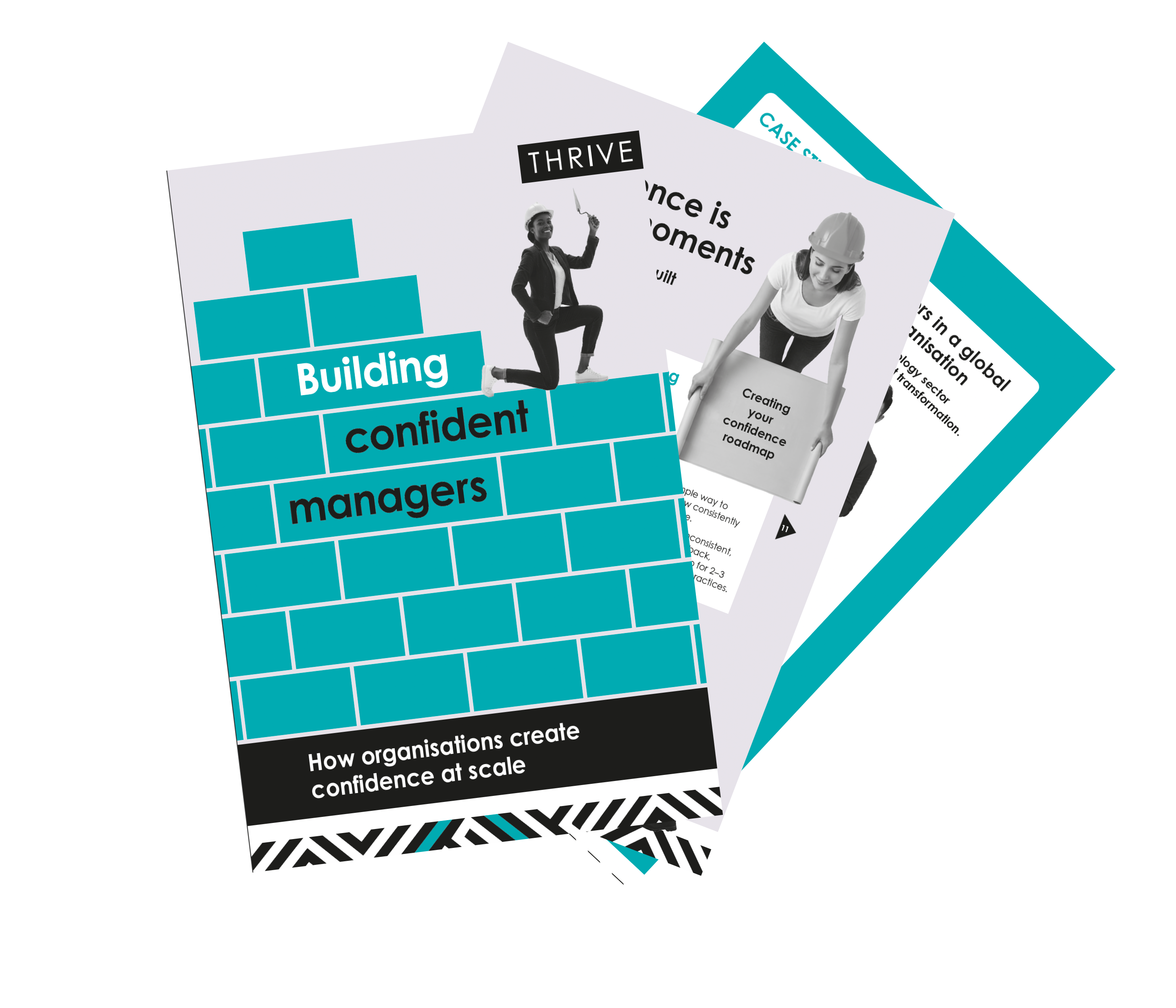
Building Confident Managers: How Organisations Create Confidence at Scale
Most organisations don’t have a training problem — they have a confidence problem. Download this practical guide to build the conditions where managers act with clarity, handle tough conversations, and make decisions without hesitation.
Why this matters
Managers are being asked to lead through uncertainty, hold difficult conversations, and balance performance with wellbeing — consistently.
But in hybrid and fast-changing environments, many managers are operating without regular feedback, visible progress, or clear signals that they’re on track. When those conditions are missing, confidence becomes fragile — and performance becomes inconsistent.
Managers drive up to 70% of the difference in team engagement, yet nearly half feel unprepared to lead (Gallup, 2023). The result: slower decisions, avoided conversations, and uneven performance.
Who it’s for
This asset is designed for organisations that want managers who:
- make timely decisions without overthinking
- have the conversation they’ve been avoiding
- coach rather than default to telling
- lead with consistency across teams and regions
Ideal for HR, L&D, People teams, and senior leaders building manager effectiveness in hybrid environments.
What you’ll learn in the guide
This guide shows how to move from capability building to confidence enabling — so managers don’t just know what good looks like, they can do it in the moment.
Inside, you’ll get:
- The real confidence gap in management (and why it’s not solved by more training)
- What confidence looks like in practice — action without certainty, faster recovery, stronger conversations
- The Manager Confidence Loop: Try → Feedback → Reflect → Adjust → Repeat (how confidence is built through repetition)
- The conditions that shape confidence at scale: clarity, feedback, progress, safety and practice
- The biggest barrier most organisations face: feedback avoidance (and how to make feedback usable in the moment)
- A simple tool managers can use immediately: the AID feedback model (Action → Impact → Do)